

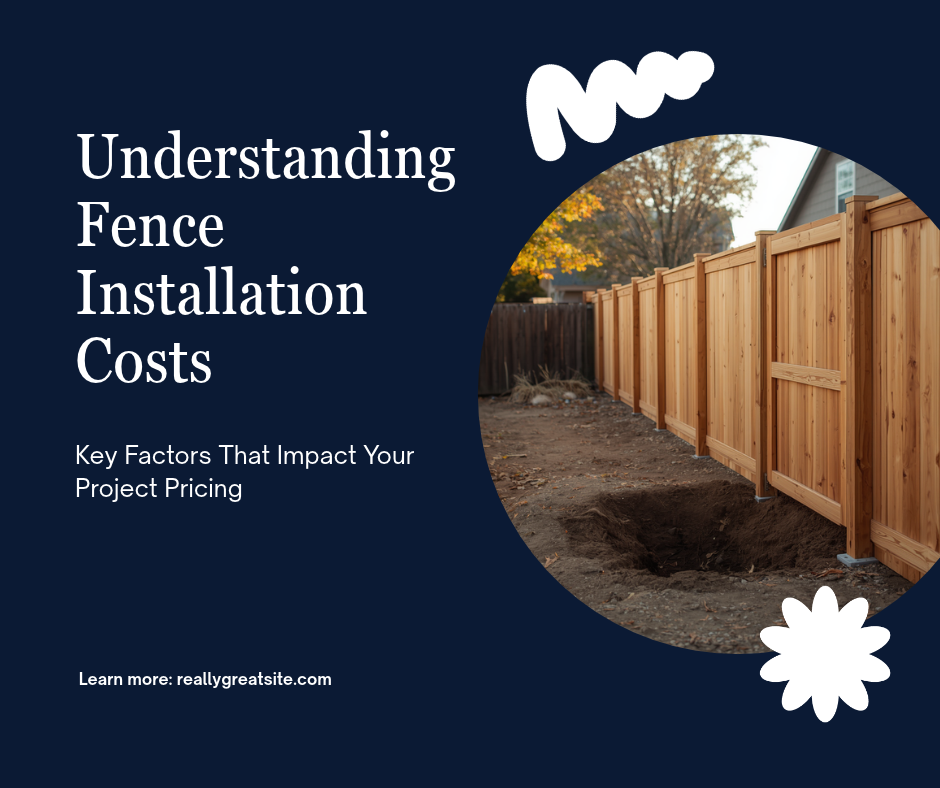
Ask three neighbors what they paid for a new fence and you’ll likely get three different numbers, even on the same street. Fence installation cost in North Houston depends on more than how many feet of fence you need. Material, site conditions, gates, and even which city or HOA you fall under all move the number up or down before a single post goes in the ground. Here are the seven factors that matter most when you’re budgeting for a new fence.
Why the Same Fence Can Price Differently Two Lots Over
A quote isn’t just a per-foot number multiplied out. Two homeowners can ask for the same height, same material, and the same length of fence and still get different prices once a crew actually walks the property, because what’s underfoot, how the lot is shaped, and what the city or HOA requires can all add or subtract hours of labor. Here’s what typically moves the number.
1. Material Choice
Material is usually the biggest swing factor in any quote. Chain link tends to sit on the economical end, wood and cedar fall in the middle depending on the grade of lumber, and vinyl, aluminum, steel ornamental, and composite usually cost more upfront, trading a higher price today for less maintenance or a longer lifespan down the road. Every material also has its own hardware, post spacing, and labor requirements behind the scenes, which is why two fences that look similar from the street can land far apart on price. See our pricing guide for current ballpark ranges by material before you start comparing quotes.
2. Height and Style
A 4-foot fence needs less material and fewer structural posts than a 6-foot privacy fence running the same distance. Style adds its own cost on top of height: a board-on-board privacy design can use close to twice the pickets of a spaced picket or semi-privacy fence, and a horizontal-plank fence needs extra blocking and fastening that a standard vertical fence doesn’t. None of that shows up as a dramatic difference on a drawing, but it adds real labor hours once a crew is actually building it.
3. Linear Footage and Lot Shape
More feet of fence costs more, but the shape of the lot matters almost as much as the total length. Every corner, jog, or odd angle needs its own post and its own cuts, so an irregularly shaped yard with several turns usually costs more per foot than a simple rectangle with the same total footage. A lot backing up to a greenbelt, drainage easement, or another HOA common area can add its own wrinkle too, since that boundary line often needs to be confirmed before anyone digs.
4. Number and Size of Gates
A gate almost always costs more than a matching section of plain fence. It needs its own hardware, and a stronger post on each side to handle the leverage every time it swings open and shut, plus a header or extra bracing on wider spans. A single walk gate adds a modest amount to a quote; a double drive gate wide enough for a truck, trailer, or boat adds considerably more, especially once you add an automatic opener into the mix.
5. What’s Actually in the Ground
Ground conditions aren’t the same on every lot we work on, and that changes how long a post takes to set right, not just how deep it goes. A lot backing up to a drainage easement, a bayou, or sitting inside a floodplain, which describes a fair number of yards across our service area, can mean a hole that sloughs in or holds water longer than a standard lot a block away. We never pour concrete into a hole that’s holding water, so a gravel base sometimes takes the place of a straight pour when that happens. We read the actual hole before quoting depth rather than pricing every lot the same way. Our FAQ on why fence posts fail goes into more detail on what we’re watching for underground.
6. Permits, Surveys, and HOA Approval
Depending on your city, a new fence may need a permit, and it almost always needs to respect setback and easement rules tied to your property line. Many HOA communities add another layer on top of that: specific materials, heights, or colors need board approval before installation, even in cities that don’t require a permit at all. Sorting this out before the crew shows up keeps the project on schedule instead of pausing mid-install for a revision. Our FAQ on fence permits by jurisdiction breaks down how this varies across the cities we serve.
7. Removing an Old Fence First
If an existing fence has to come down before the new one goes up, tear-out and haul-away add labor and disposal cost on top of the installation itself. A fence that’s leaning but still mostly intact usually comes out faster than one that’s rotted through and falling apart board by board, since more of a badly deteriorated fence has to be handled and hauled away in pieces rather than pulled out in sections.
Getting an Accurate Number
The fastest way to get a real number is a walk-through, not a guess over the phone. Once we’ve seen the lot, measured the gates, and checked what’s underfoot, we can tell you which of these seven factors apply to your project and which don’t. Book a free estimate or call 281-973-3884, and we’ll give you a number that accounts for your actual property, not a flat rate per foot.

