

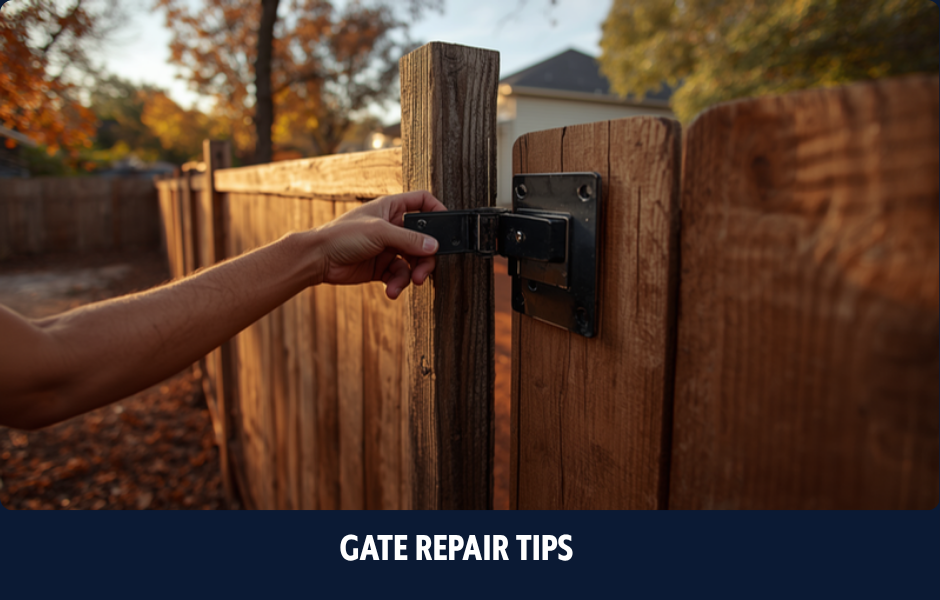
A sagging fence gate is one of the most common repair calls we get in North Houston, and it almost never means the whole fence is failing. Before you reach for a new gate, it helps to know what’s actually pulling it out of square. In our climate, a sagging fence gate usually comes down to one of three things: a gate post that has shifted in our clay soil, hardware that has worn out, or a wood frame that has racked out of square from humidity swings. Each one has a different fix, and guessing wrong means redoing the work twice.
What Causes a Sagging Fence Gate in Houston
Gates take more abuse than any other part of a fence because they’re the only part that moves. A few things specific to this area make that worse.
- Clay soil movement. Our expansive clay soil swells when wet and shrinks when dry, and a gate post at the edge of a fence line feels that movement more than posts in the middle of a run. If the post has leaned or twisted, the whole gate frame goes out of plumb with it. See why fence posts fail in Houston clay soil for how that happens underground.
- Humidity and wood movement. Wood gate frames absorb moisture through a humid Gulf Coast summer and dry out again in fall and winter. That swelling and shrinking loosens screws and opens joints at the corners, which is a big reason gates that closed perfectly in June start dragging by October.
- Worn or undersized hardware. Standard hinges and a single drop-rod latch are often undersized for a tall, solid privacy gate. Over time the hinge screws work loose in the post and the gate drops at the latch side.
Diagnose Before You Fix Anything
Check the hinges first
Grab the gate at the latch end and lift gently. If it moves up and down at the hinge side, the screws have worked loose or stripped out their holes. This is the cheapest fix on the list and the most common cause of a gate that has only recently started to sag.
Check the gate post
Hold a level against the hinge post. If the post itself is out of plumb, no amount of hinge tightening will fix the gate for long, since the whole frame the hinges are attached to is tilted. This is the clay soil scenario, and it’s worth a closer look rather than a quick patch.
Check the gate frame for racking
If the post is plumb and the hinges are tight but the gate still looks like a parallelogram instead of a rectangle, the frame itself has racked. That’s usually a wood gate without a diagonal brace, or one where the brace has come loose. This calls for a frame repair, not a post or hardware fix.
Simple Fixes You Can Handle Yourself
If the hinges are the problem, start here before assuming you need a new gate:
- Replace stripped hinge screws with longer, exterior-rated deck screws instead of the short screws that ship with most hinge kits.
- If the screw holes are stripped out, pack them with wood glue and toothpicks or a dowel, let them dry, and redrill. The new screws will have something solid to bite into.
- Add a diagonal turnbuckle brace, sometimes called an anti-sag kit, from the top of the hinge corner to the bottom of the latch corner. Tightening it pulls a mildly racked frame back square and is one of the most effective fixes for the money.
- Upgrade to heavier-duty hinges if your gate is a tall, solid privacy style. The hardware that comes standard with most gate kits is undersized for a 6-foot board-on-board gate.
When the Gate Post Needs to Be Reset
If your diagnosis points to the post, tightening hardware is only a temporary patch. A leaning gate post needs to be reset in fresh concrete, often deeper than before or paired with a steel post for extra support. We walked through that process in how to fix a leaning fence post in Houston clay soil, and the same principles apply whether the post anchors a gate or sits mid-fence.
Gate posts carry more leverage than a standard fence post because of the weight swinging off one side, so if yours has failed once, ask about a steel post rather than resetting another wood one in the same spot. Our fence repair and replacement team can tell you which approach makes sense once we’ve seen it in person.
Preventing the Next Sag
A little fall maintenance goes a long way here. Walk your gates now, while temperatures and humidity are both dropping, and tighten anything that worked loose over the summer. If you’re installing a new gate, ask about a diagonal brace up front, and consider steel or aluminum framing for any gate that sees daily use, since it won’t swell and shrink with the seasons the way wood does. We cover the styles and hardware options we install most often on our gates page, from solar-powered automatic openers to heavy-duty commercial hinges.
If your fence has an issue too big to DIY, book a free estimate or call 281-973-3884. We serve The Woodlands, Spring, Conroe, Magnolia, Kingwood, Humble, and the rest of North Houston, Montgomery County, and Deep East Texas.

